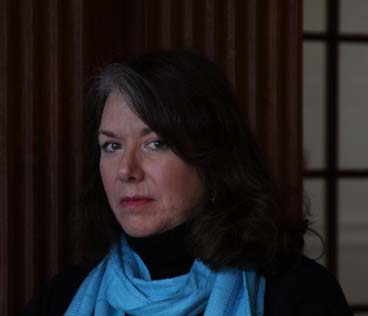
Randi Davenport studied history and creative writing at William Smith College, where she earned her B.A; she later earned both an MA in Creative Writing/Fiction and a PhD in literature at Syracuse University, where she won the university-wide prize for best doctoral dissertation of the year. She has been a Summer Fellow of the National Endowment for the Humanities, a Public Fellow at the Institute for Arts and Humanities at the University of North Carolina at Chapel Hill, and has taught literature and writing at Hobart and William Smith Colleges, Duke University, and the University of North Carolina at Chapel Hill, among others. She is currently the Executive Director of the James M. Johnston Center for Undergraduate Excellence at the University of North Carolina at Chapel Hill.
Her short fiction and essays
have appeared in publications like The Washington Post, The
Ontario Review, The Alaska Quarterly
Review, Literature/Film Quarterly, Victorian Literature
and Culture, and Women’s History Review.
Q and A With Randi Davenport
Q: Mental illness is something that most people don’t want to discuss, even those who experience it in their own families. A stigma still remains. Why did you want to write about mental illness?
A: I didn’t set out to write about mental illness. I would have found that subject to be very daunting. I set out to write about my son, whom I love very much, and what happened to him and our struggles to find him appropriate care. Originally, I imagined writing a short piece for our local independent newspaper, highlighting the issues that families were facing as the state of North Carolina undertook mental health care reform. So I went to the mountains for a week and sat down to write that piece and at week’s end, I had 100 pages. This was obviously too long for a short piece in the local paper. And it was clear to me that I had lots more to say about my son and our family and I decided to follow that impulse and see where it led me. As I wrote, the story began to emerge. So when I began, I had not imagined writing a book at all, let alone a book about mental illness. In some ways, I feel like I tricked myself into doing it. And perhaps this was the only way I would have ever been able to tackle the subject.
Q: This is a very emotional subject. Did you find it easy to write about your son’s illness? Or was it a kind of therapy for you?
A: No and no. It was excruciating to write about what happened to my son. And I knew that if I told his story, I had to tell it in the most authentic and genuine way I could—I could not be in any way evasive and I could not let myself smooth things over or try to make things other than as they were. I had to make sure I was true to the core of things. And I very much wanted anyone who read this story to focus on my son and his humanity, although I probably wouldn’t have put it in those terms during the writing. I would merely have said that I was writing about Chase, which meant for me that I was writing about love. And when I wrote about my daughter, the love story only got bigger. But I did not need to write this story to uncover the truth of my love for them. It wasn’t therapeutic. I wanted to write about what I knew to be real already.
Q: Many families have to deal with mental illness. Isn’t your family unique in that your experiences were much more brutal than most?
A: The saddest part of the story I have to tell is how common it is. Perhaps the difficulty of diagnosis and the slipperiness and severity of his symptoms made my son a bit different than other individuals who have to walk this path, but our interactions with the system and the system’s inability to serve—these experiences are all too common. We simply do not do a good job of caring for individuals who suffer diseases we stigmatize. And we all carry some degree of prejudice where these individuals are concerned. We look the other way. We accept unsatisfactory solutions. I once heard someone say that mental illness was mysterious and unsolvable so we should not commit any resources to it—we should just put funding elsewhere and to better use. Try as we might, and there are many really good people working very hard for solutions, American society tends to mis-treat these people, profoundly and consistently and blindly. If you have a family member with a mental illness, you should not have to be an extraordinary advocate in order to provide him or her with basic care for his or her illness. But you will need to be that, even under the best circumstances. And usually, when you most need to fight, you are experiencing the most devastating aspects of the disease process in your loved one. It’s really unconscionable but it’s the sad reality.
Q: Do you think of your son as someone with a mental illness? Isn’t he also developmentally disabled?
I think of my son as my son. I know him as a human being, first and foremost. Neurologically, something has gone wrong. Whatever that is, it has manifested in ways that look like both mental illness and developmental disability and for him, each of the categories has been dominant at different times. This is why I focus on his experiences as symptomatic of a mal-functioning brain. At some points in the last century, it might have been helpful to categorize and separate individuals into these two different tracks—you’d diagnose a child with autism rather than mental illness because it opened up a range of therapies and services that had been carefully set apart from those available to someone diagnosed with a childhood psychosis. To me, this is simply evidence of the deep stigma attached to mental illness—you wanted to save these kids, so you made sure the language that attached to them was the language of developmental disability, not the language of mental illness. But research in the fields of neurosciences and genetics is changing our vocabulary and increasingly giving us the physiological processes that create symptoms. We aren’t there yet—we don’t have genetic subtypes pinned down for autism, for example, and the workings of the schizophrenic brain remain unknown to us in many ways—but as these advances continue, I wonder if we might establish ways to see people with mental illness as people with a disease, not people who are morally flawed or possessed by demons or in some way freakish in nature or responsible for their own suffering. It’s long past time for that to happen.
Q: How did you find the strength to do what you had to do to take care of your family? Your efforts seem almost super-human.
A: I resist anyone’s attempts to suggest that I was heroic in any way. I am a parent and I had to take care of my kids. In the thick of it, I wasn’t really thinking about what was happening in a big picture sort of way. I merely did what I had to do, day after day, and hoped for the best. Things didn’t go as I hoped they would but that didn’t mean I was supposed to give up. And I’m not unique. There are lots of parents who are doing this every day. We love our families and we want to see them thrive and flourish. And I guess I have an odd form of optimism. I really do believe, even when all evidence runs to the contrary, that it is possible for things to get better. So I think I often operated on hope alone. Somehow, that must have sustained me. But it doesn’t make me a hero. Far from it.
Q: How do your children feel about this book? Have they read it?
A: I think they are proud. My son has been very pleased to see it. He held the bound galleys in his hands and said, “It came out.” The look on his face was wonderful to behold. My daughter would like for me to buy her a horse. She also thinks it would have behooved me not to mention her role in the Wax Museum project held at her school when she was in the third grade. Both Chase and Haley have had many opportunities to read the book but so far, neither has chosen to do so. I like to think that they will come to it in their own time but I also think my daughter is probably right when she says she doesn’t have to read it because she lived it. Reading the book is completely up to them. I will understand if they never want to open it.
Q: What is your life with Chase and Haley like now?
As peaceful as we’ve ever known it. Chase visits regularly and Haley is nearly ready to go to college. We like to talk about the old days but we’re looking forward to the days to come, too. It’s very sweet to be together.